
Research methods
Moderated Usability Study, Interviews
Industry
Banking
Role
Lead UX Researcher
Year
2023
Buying a house as
an expat
In this case study for one of the largest banks for the Netherlands, expats share their opinions about a new mortgage concept, and a mobile prototype. The results of the study helped the bank become a market leader in expat mortgages.
Research summary
We interviewed six expats who were interested in buying a house in the Netherlands. In these interviews, participants shared their needs and challenges when it comes to getting a mortgage, gave their feedback on a new mortgage concept and reviewed a website prototype. The concept was very well received, but there was room for improvement regarding the prototype. The main two issues we identified are the usability of the mortgage calculation tool, and the lack of trust towards testimonials.
Research questions
A new landing page had been created, containing all information that the team thought was valuable for an expat. The problem? They were merely assumptions. In this project, we aim to:
-
Study how the prototype is experienced by the target audience
-
Understand what expats need when it comes to getting a mortgage in the Netherlands
-
Get insight into expats' expectations of the role of a bank in the mortgage process
A tricky sample
Two of the participants were recruited and interviewed by the client. I was tasked to recruit four more expats willing to participate in the interview.
More challenging than I expected! The recruitment criteria were so limiting, that I was able to find only one person through my trusted panel. That meant I had to get creative. I decided to use my own (extended) network to recruit the remaining participants. I chose to exclude close friends, as a close relationship between the interviewer and the interviewee can impact the results. Moreover, a large part of the sample consisting of friends, would increase the risk of participants being too similar.


Time to start: Moderated Usability Testing
In Ms Teams sessions, participants were presented with a Figma prototype. They were asked to open it, to browse the website as they normally would, and to think out loud while doing so. This very broad use case allowed me to observe which pages, links and functionalities caught the respondents eye. Using a checklist, I tracked which pre-defined core pages were visited naturally and in which order. If one of the pages was not used at all, I would propose an additional use case on the topic, to still gather their feedback on the content.
The Moderated Usability Test was concluded with a set of interview questions about the specific pages, as well as the overall experience.
Desirability toolkit
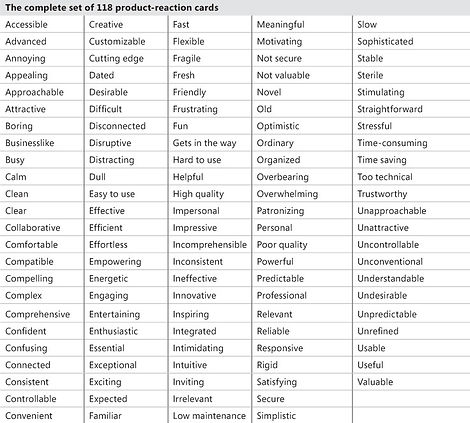
At the end of the session, we used the Desirability Toolkit. This is a method developed by Microsoft, where participants are asked to quickly select the pre-defined reaction words that best describe the look and feel of a website.
The original list consists of 118 reaction words. As this is quite a long read, we reduced it to the 25 words that we believed were most applicable to the product.
It was my first time trying out this method. I liked how using a controlled vocabulary helped quantify the results. Interestingly, participants were pretty unanimous.
Results
A detailed report was created in collaboration with the client. The results section of the report was divided in three subsections: Assumption validation, an in-depth analysis per prototype page, and the desirability toolkit results. Below are some examples of the report content.
Assumption validation
Prior to the start of the test, a list of assumptions regarding expats' experience were defined by stakeholders. Based on the comparison between these assumptions and the data we obtained, we were able to create a traffic light diagram. This is an organized way of summarizing the most important results.

In-depth analysis of main issues
We analyzed the feedback that was given on each of the prototype pages, and identified any issues. All issues were illustrated with quotes or video snippets from the interview recording. Below are two examples of critical issues on the website:
01
Testimonials are considered untrustworthy
Two of the core pages of the prototype featured testimonials from other expats who'd gotten a mortgage with the bank. More than half of the respondents did not trust them. They believe that banks will only show the success stories, which paints an unrealistic picture of the average process. Some even believe that testimonials are made up.
02
The mortgage calculation tools are insufficient
The maximum mortgage is calculated based on income. However, multiple respondents mentioned that they want to input their savings or a contribution from their parents. They were uncertain that without this information, the maximum mortgage would be accurate.
Quotes
"Stories in testimonials are always positive, so I don't really trust that. Even the pictures look fake to me."
"I don't even read these because of course a bank would only show the success stories."
Quotes
"I would probably get some help from my parents, but it seems like I can't put that anywhere?"
"How can they calculate my maximum mortgage when they don't know how much savings I have?"
Desirability toolkit results
A simple analysis of the desirability toolkit results shows that 97% of the chosen reaction words were positive (see table for the two outliers). The words reassuring, accessible and supportive were chosen most often. This was a strong indication that the goal of the concept was achieved.

In an ideal world...
The goal of the prototype was to convince expats to plan a call with a mortgage advisor at the bank. How expats experience the rest of the mortgage process remains unknown. If I would have been in the position to suggest a follow-up study, I would have loved to follow some of expats throughout the entire mortgage process. This would not only give insights into the broader experience of expats with the bank, but might also lead to fresh ideas for the mortgage website. After all, expats might gain valuable insights throughout the process, that they wished they had known from the get-go.
Learnings
I conducted this research in close collaboration with my client, also a UX Researcher. In this collaboration, I learned to work with the traffic light diagram to test assumptions. A practice that I have since used in many of my studies.
I also had my first experience with the Desirability Toolkit. As mentioned before, I think it's a great way to quantify the experience of look and feel.
Curious what I can do for your project?